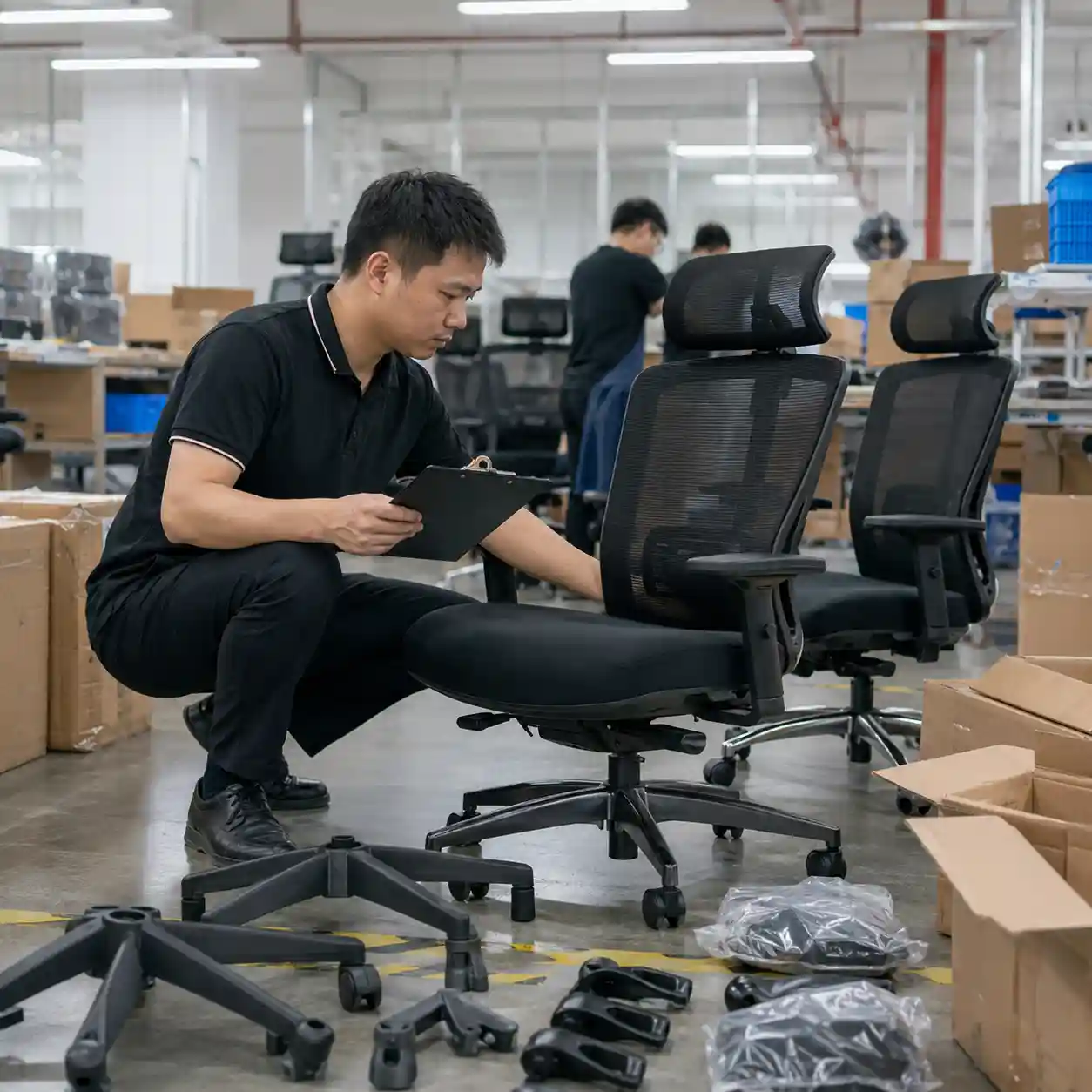
Bar stools often look simple, but comfort depends on more than a padded seat or attractive upholstery.
A stool can still feel uncomfortable when the seat is too high, the footrest is poorly positioned, the knees hit the counter, the seat is too narrow, the backrest provides little support, or the frame moves during use.
For restaurants, bars, cafes, hotels, and furniture distributors, these problems affect more than one person. A small design mismatch can be repeated across an entire seating program.
This guide explains why bar stools become uncomfortable and what buyers should check before choosing a commercial model or approving a bulk order.
The Short Answer: Comfort Is a Fit Problem
① Seat Height Must Match the Surface
The first check is the distance between the stool seat and the underside of the counter or bar.
Many buying guides use approximately 10 to 12 inches of clearance as a starting point. Houzz y Restaurant Furniture both recommend measuring the surface first and then selecting the stool height, rather than choosing by appearance alone.
This clearance is not a universal comfort guarantee. The actual result also depends on the user’s height, counter depth, front-panel position, seat shape, armrests, and whether the user needs to lean forward while eating or working.
A stool may technically be the correct height and still feel wrong if the knees hit the counter or the user cannot sit close enough to the surface.

② Feet Need Stable Support
At bar height, many users cannot place both feet flat on the floor. The footrest becomes part of the seating system.
A useful footrest should allow the user to rest the feet without sharply bending the knees or pressing against a narrow metal edge. Almeco notes that footrests are essential for taller seating and should be checked for wear because shoes place repeated pressure on them.
The footrest should also be checked for:
- Position below the seat
- Width and surface shape
- Connection to the frame or base
- Resistance to repeated stepping
- Acabado superficial
- Ease of cleaning
- Whether it becomes loose after assembly
A decorative footrest that is uncomfortable or weak will not solve the main seating problem.
③ Seat, Backrest and Footrest Work Together
A comfortable commercial bar stool is not defined by one component.
A soft seat cannot compensate for a poor height. A high backrest cannot compensate for a badly positioned footrest. A strong metal base cannot compensate for a seat that creates pressure behind the knees.
The most comfortable result usually comes from a combination of correct seat height, practical seat depth, enough usable seat width, stable foot support, a backrest that matches the intended sitting time, and a base that does not shift or wobble.
Domino’s consumer guide also highlights padding, seat size, back support, and foot placement as separate parts of the comfort decision.
What Customers Actually Feel in Real Use
Public discussions from consumers repeatedly mention dangling feet, poor footrests, weak back support, uncomfortable seat proportions, and unstable frames. These are individual experiences rather than laboratory data, but they are useful prompts for a commercial sample checklist.
| Customer complaint | Possible cause | What to check in a sample |
|---|
| Feet feel tired or numb | No practical footrest or incorrect footrest position | Test the footrest at the real counter height |
| Knees hit the counter | Insufficient clearance or excessive seat height | Measure from the seat to the underside of the counter |
| Lower back feels unsupported | Backrest too short, too upright, or poorly angled | Check the contact area while sitting normally |
| Stool feels unsafe | Loose joints, unstable base, or poor adjustment | Test static sitting, turning, and getting on and off |
| Upholstery looks worn quickly | Material is not suitable for repeated cleaning or friction | Review material samples and cleaning requirements |
① Dangling Feet and Poor Footrests
Users often describe bar seating as uncomfortable because their feet cannot find a stable position. Some mention ankle strain, pressure behind the thighs, or the feeling that the stool is too high.
A public Reddit discussion about bar seating described discomfort caused by dangling feet and a lack of foot support. Another discussion focused on foot rails that were too low or positioned for only a narrow range of body heights. These comments are anecdotal, but they point to a practical issue: the footrest needs to work for the intended users, not just appear in the product photo.
For a restaurant buyer, the right question is not simply whether the stool has a footrest. The better questions are:
- Can users reach it naturally?
- Can they change foot position?
- Does it support the leg without creating pressure?
- Can it withstand repeated use?
- Is it easy to clean?
② Hard, Narrow or Poorly Shaped Seats
A seat can be padded and still feel uncomfortable.
Common problems include a narrow sitting area, an unexpected slope, a hard front edge, uneven foam recovery, too much depth for shorter users, too little depth for taller users, or a cushion that shifts during use.
Seat comfort should be checked with the body in a normal position, not only by pressing the cushion with a hand.
For mixed-height users, a model that feels comfortable to one person may not work equally well for everyone. This is one reason commercial buyers should approve a physical sample before placing a larger order.
③ Backrests That Look Supportive but Are Not
A backrest can improve comfort, but its size and angle matter.
A very short back may only provide visual support. A hard or overly upright back may encourage the user to lean forward. A wide backrest can also create spacing problems when multiple stools are placed together.
When checking a backrest, observe:
- Where it contacts the back
- Whether it supports the lower back or only the upper body
- Whether the user can sit without sliding forward
- Whether the back edge creates pressure
- Whether the backrest interferes with the counter or table
For quick-service cafes, a backless stool may be practical because it takes up less space. For restaurants, cocktail bars, and hotel seating where guests stay longer, a backed model may be more appropriate.
The correct choice depends on the venue, not on the general claim that one type is always more comfortable.
④ Wobbling, Loose Hardware and Assembly Problems
A stool that moves unexpectedly will feel uncomfortable even when its seat is well padded.
Consumers frequently complain about wobbling bases, loose screws, seat sections that do not align, moving footrests, height-adjustment mechanisms that do not hold position, and missing or unclear assembly hardware.
A public product discussion described wobbling, loose hardware, difficult adjustment, and missing floor-protection parts. These reports are not a substitute for controlled testing, but they show why buyers should inspect the assembled product rather than judge only the catalog image.
The sample review should include:
- Tightening all fasteners
- Checking the base on a flat floor
- Testing the swivel or adjustment mechanism
- Applying normal foot pressure to the footrest
- Sitting down from different angles
- Checking whether the seat remains aligned with the base
⑤ Upholstery That Ages Poorly
A bar stool may look attractive when new and still be a poor fit for a high-use venue.
Restaurant and bar seating can be exposed to food and drink spills, frequent wiping, friction from clothing, direct sunlight, repeated contact with shoes, cleaning chemicals, and changes in temperature or humidity.
Manhattan Comfort’s commercial guide explains that different upholstery materials involve different cleaning and durability trade-offs, while Almeco recommends asking about materials suitable for repeated hospitality use.
The buyer should request:
- Material name
- Acabado superficial
- Cleaning instructions
- Color or texture sample
- Seam and edge details
- Confirmation of whether the material is intended for the target environment
Avoid choosing upholstery based only on a catalog image.
7 Checks Before Choosing Commercial Bar Stools
① Measure the Complete Seating Geometry
Record more than the counter height.
Measure the floor-to-counter height, countertop thickness, underside clearance, counter overhang, available seat width, depth behind the stool, space required to pull the stool out, and the height and position of any arms.
If the stool has arms, include them in the clearance calculation. A model may fit by seat height but fail when the arms cannot slide under the counter.
② Check the Seat Shape and Front Edge
Look at the complete seat, not only the cushion thickness.
Check whether the seat supports the body without forcing one position, whether the front edge presses into the legs, whether the seat depth suits the target users, whether the cushion remains stable, whether the surface is easy to clean, and whether the stitching and edges are consistent.
For a restaurant project, comfort also includes how quickly guests can sit down, turn, leave, and return to the stool.
③ Check Footrest Position and Construction
The footrest should be treated as a structural and comfort component.
Ask whether it is integrated into the frame or attached separately, whether it can support repeated foot pressure, whether the surface is likely to become slippery, whether it can be cleaned easily, whether the finish resists visible wear, and whether it remains stable after assembly.
④ Compare Backless, Low-Back and High-Back Models
Backless stools are easier to move and often work well where space and turnover matter.
Low-back stools can provide some support without visually blocking the bar.
High-back stools may be better for longer dining, hotel lounges, or cocktail settings, but they usually require more space and may be harder to tuck away.
The choice should follow the use case:
- Short visits and compact spaces: consider backless or low-back models.
- Longer meals and social seating: consider a model with more back support.
- Mixed commercial projects: compare more than one configuration during sampling.
⑤ Check Fixed, Swivel and Adjustable Functions
Swivel functions can make it easier for users to turn, enter, or leave the seat. Adjustable height can help when one seating program serves different surfaces.
However, every moving component creates another point to inspect.
For swivel or adjustable models, test smooth movement, unwanted side-to-side play, locking performance, noise, alignment after adjustment, and stability at the highest and lowest positions.
Almeco notes that swivel stools have more moving parts and should be selected with commercial-quality construction in mind.
⑥ Review Upholstery and Cleaning Requirements
Select materials based on the venue rather than only on color.
PU leather may be practical where wiping and visual consistency matter. Fabric may support a softer appearance but requires a clear cleaning plan. Textured materials may suit boutique interiors but need closer review for stains and maintenance.
The supplier should provide written material information and cleaning guidance for the approved sample.
⑦ Inspect the Base, Joints and Floor Protection
The base affects both comfort and perceived quality.
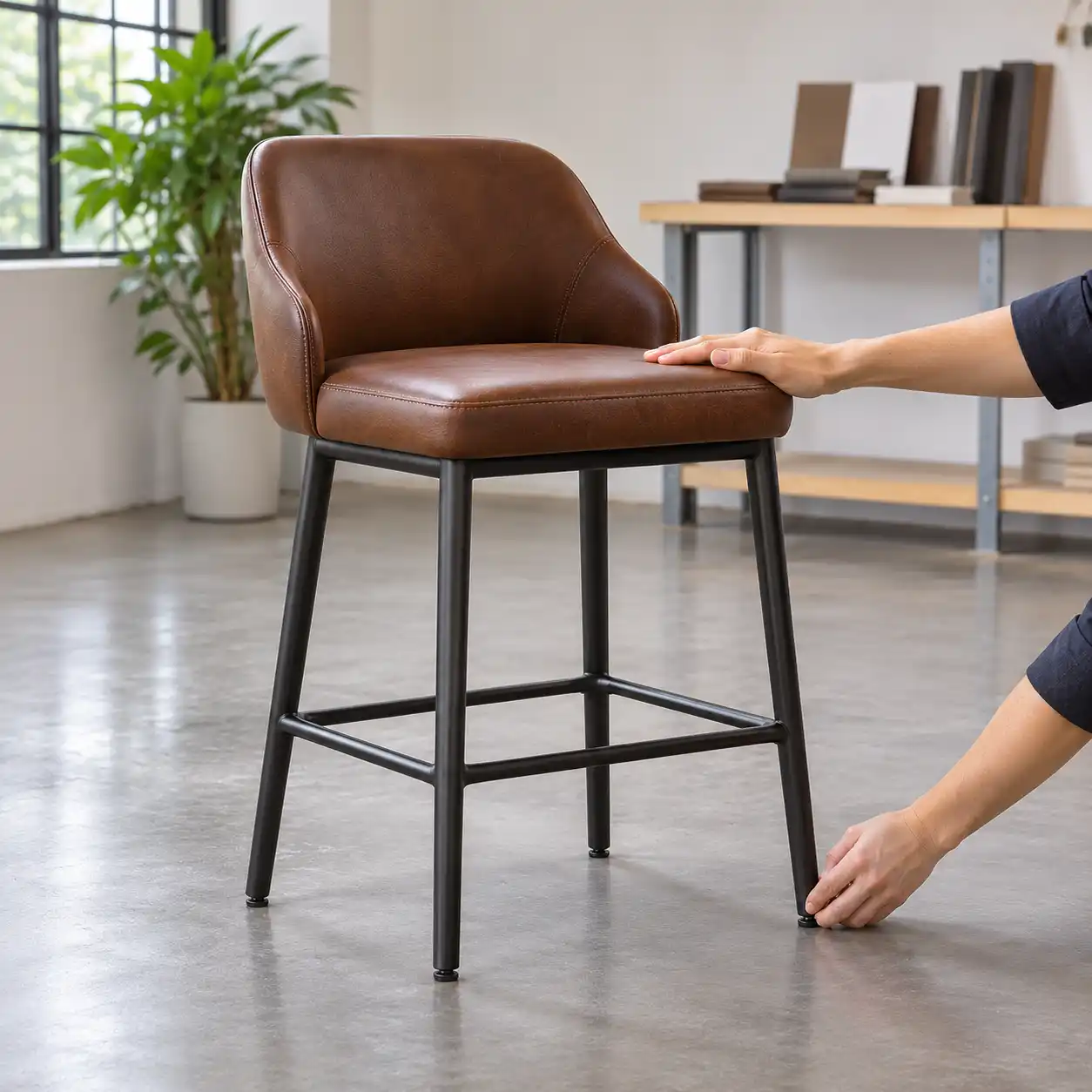
Inspect the base width, contact with the floor, joint movement, weld or connection consistency, foot pads, floor protection, resistance to rocking, and alignment between the seat and base.
A stool that scratches the floor or rocks on a flat surface will create complaints even if it looks attractive in a showroom.
How to Test a Bar Stool Sample Before Bulk Production
① Test It at the Actual Counter
Place the sample at a counter or table with the same working height as the target project.
Check whether the knees fit comfortably, whether the user can sit close enough to the surface, whether the footrest is reachable, whether the backrest supports a normal sitting position, and whether the stool can be pulled out without hitting nearby furniture.
A sample should be tested in the position where it will actually be used.
② Test Different Users and Sitting Positions
One person cannot represent every end user.
Where possible, record feedback from people with different heights, leg lengths, body sizes, sitting habits, and expected sitting durations.
Ask specific questions instead of only asking, “Is it comfortable?”
- Where do you feel pressure?
- Can you rest both feet?
- Can you sit close to the counter?
- Do you feel stable when turning?
- Would you choose this seat for a longer meal?
③ Test Movement and Stability
Test the stool while sitting down, standing up, turning, resting the feet, leaning lightly against the backrest, and moving the stool on the floor.
The goal is not to create extreme conditions. The goal is to reproduce normal use and identify movement that customers would notice.
④ Test Assembly and Repeatability
Record the assembly process and check hardware quantity, assembly instructions, seat direction, footrest alignment, base connection, adjustment mechanism, and final stability.
For a bulk order, repeat the assembly on more than one unit when possible. A single good sample does not automatically prove that every unit will be identical.
How to Turn Comfort Requirements Into a Bulk Order Brief
① Write the Product Requirements Clearly
A useful brief should include the venue type, intended use, order quantity, counter or bar height, target seat height, backrest preference, footrest requirement, fixed or swivel function, upholstery material, color and finish, packaging requirements, destination market, and sample approval process.
Clear information allows suppliers to recommend a model for the actual project rather than quote a visually similar item.
② Ask for Evidence, Not Only Descriptions
Terms such as “comfortable,” “ergonomic,” and “commercial quality” need to be connected to details.
Ask the supplier for dimension sheets, material samples, product photos from multiple angles, assembly instructions, function videos where relevant, packaging information, available inspection records, and replacement or spare-parts information.
The buyer should separate confirmed specifications from claims that still need to be checked on a sample.
③ Approve the Sample Before Confirming the Bulk Order
The approved sample should become the reference for seat height, materials, color, stitching, footrest position, base finish, functional parts, labeling, and carton protection.
Any change after approval should be recorded and accepted before mass production.
Which Bar Stool Configuration Fits Different Venues?
① Quick-Turnover Cafés and Compact Seating
A backless or low-back model may be practical when space, movement, and cleaning are important.
The buyer should still check seat comfort, foot support, and stability. Compact does not have to mean uncomfortable, but the reduced structure needs to be balanced by a suitable seat and footrest.
② Restaurants and Cocktail Bars
Restaurants often need a balance between comfort, appearance, and cleaning.
A model with a backrest, usable footrest, and wipeable upholstery may be suitable for customers who stay longer. Swivel functions can also improve access, but the mechanism should be checked carefully.
③ Hotels, Projects and Distributor Programs
Larger programs need consistency as much as individual comfort.
The buyer should focus on repeatable dimensions, consistent materials, stable color matching, packaging protection, clear sample approval, spare-parts communication, and reliable order documentation.
A model that works for one showroom sample still needs to be evaluated as a repeatable product program.
Questions Buyers Often Ask
① Are Bar Stools With Backs More Comfortable?
Often, a backrest can provide more support for longer sitting, but it is not automatically more comfortable.
Seat height, seat depth, footrest position, back angle, and user preference all matter. A well-shaped backless stool can work for short visits, while a poorly designed backed stool can still create pressure or awkward posture.
② What Makes a Commercial Bar Stool Comfortable?
The main factors are correct height for the surface, practical knee clearance, stable foot support, suitable seat width and depth, effective back support where needed, a stable base and joints, and materials suited to the cleaning and traffic level.
The final decision should be based on a physical sample, not only on product photos.
③ How Can Buyers Reduce Wobbling Problems?
Start with the base, joints, adjustment parts, and assembly process.
Ask whether the stool remains stable on a flat floor, whether all fasteners can be tightened correctly, and whether the seat stays aligned after normal use.
If the stool is adjustable or swivel, test it at different positions instead of checking only one setting.
④ Should Restaurants Choose Fixed or Adjustable Bar Stools?
Fixed stools usually provide a consistent height across a row and may be easier to manage in a uniform commercial layout.
Adjustable stools can be useful when surfaces or users vary, but they contain more moving parts and require additional checks.
The choice should follow the venue layout, maintenance plan, and intended use.
⑤ What Should a Buyer Send to a Supplier?
At minimum, provide the counter or bar height, target quantity, intended venue, preferred seat height, backrest preference, material and color requirements, footrest expectations, packaging needs, destination market, and sample requirements.
The more clearly the buyer defines the use case, the easier it is to compare suppliers and avoid ordering a stool based only on appearance.
Related Resources for Bulk Buyers
For a broader commercial comparison, start with the wholesale bar stool collection.
Buyers comparing seat height can also review the Guía sobre la altura de los taburetes de bar.
For supplier evaluation, see the Lista de verificación para proveedores mayoristas de sillas de bar.
For models with back support, review the Lista de verificación para el comprador de taburetes de bar comerciales con respaldo.
For a product comparison path, buyers can also review the HY-BY32 PU leather counter stool and request a sample based on their project requirements.
Conclusión final
Comfortable bar stools are not created by one feature alone.
The result depends on the relationship between the counter, seat, footrest, backrest, base, materials, and intended use. For restaurants and other commercial buyers, the safest approach is to define the seating environment first, compare the complete specification, test a physical sample, and record the approved details before confirming a bulk order.
A good-looking stool can attract attention. A correctly matched, stable, and repeatable stool is what helps a seating program work in practice.



 English
 Español