A China gaming chair factory partnership can make or break your brand. Get it right, and you unlock competitive pricing, custom engineering, and reliable supply. Get it wrong, and you face inconsistent quality, missed deadlines, and warranty nightmares. With over 20 years as a factory-direct gaming chair manufacturer in China, we’ve seen both sides of this equation. This guide gives you the 7 professional checks we believe every buyer should run before placing an order.
1. Production Line & Capacity: Can They Actually Deliver?
A glossy website means nothing. The first question every buyer should ask a China gaming chair factory is: what does the production floor actually look like?
Here is what separates a full-scale manufacturer from a small assembly workshop:
- In-House Production Lines: A legitimate gaming chair manufacturer in China operates dedicated lines for metal frame welding, foam molding, upholstery cutting, and final assembly under one roof. If they outsource more than 30% of core components, quality control becomes fragmented.
- Daily Output Capacity: Ask for verified monthly throughput. A mid-to-large OEM gaming chair factory should comfortably handle 5,000–20,000+ units per month without subcontracting. Request production floor photos with timestamps, not catalog renders.
- Equipment Audit: Look for robotic welding arms, CNC tube-bending machines, automated fabric-cutting tables, and conveyor assembly systems. Manual-only workshops cannot maintain consistency at scale.
Key Question to Ask: “Can you send me a recent video of your production floor showing each stage — from raw steel tubing to finished chair packaging?”

2. Quality Control Systems: From Incoming Materials to Final Inspection
Quality is not inspected in — it is built in. A reliable China gaming chair factory operates a multi-gate QC system, not a single end-of-line check.
Demand evidence of these four QC gates:
- Incoming Material Inspection (IQC): Every batch of steel tubing, PU leather, foam, gas lifts, and casters must be tested against spec before entering production. Ask for a sample IQC report for a recent wholesale gaming chair order.
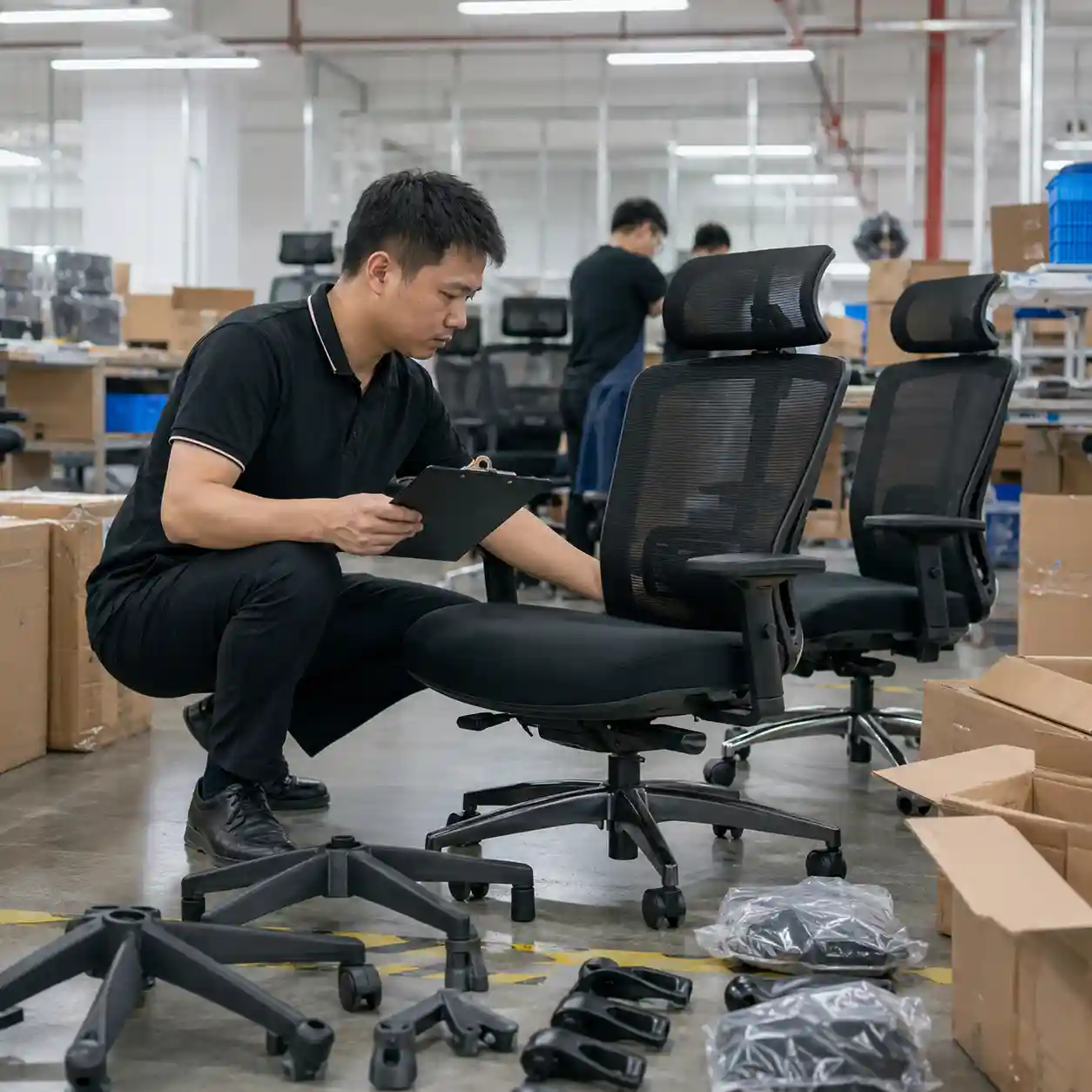
- In-Process Quality Control (IPQC): Weld integrity checks on frames, foam density testing during molding, and stitch tension verification during upholstery. These happen on the line — not after the chair is packed.
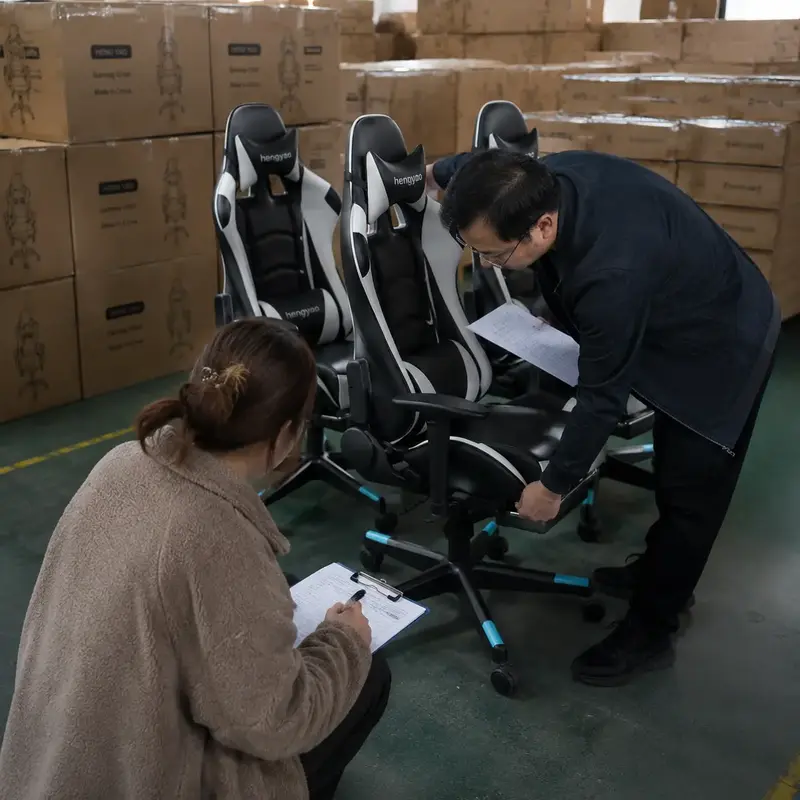
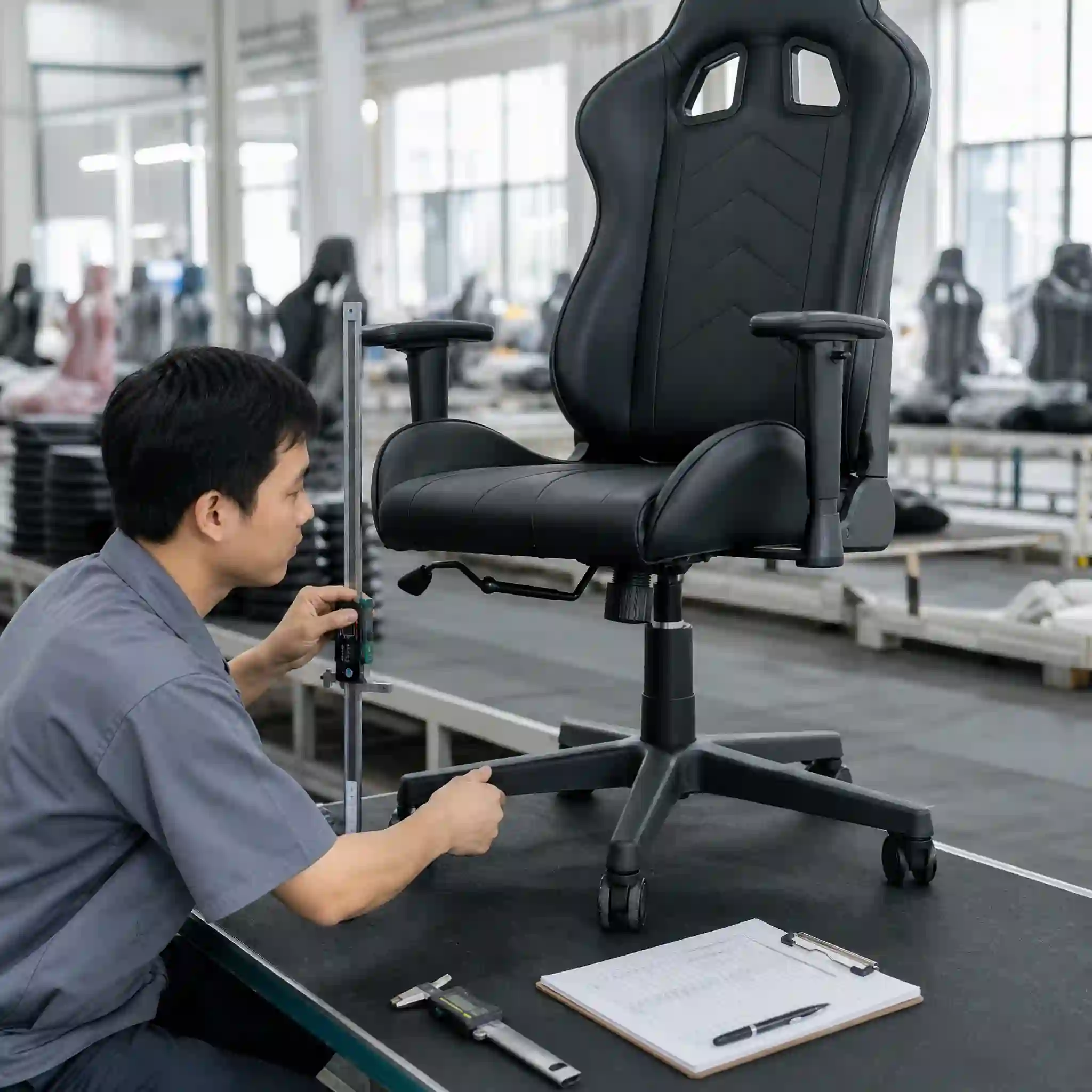
- Finished Product Audit (FQC): A random sample from each production batch undergoes full dimensional checks, static load testing, backrest durability cycling, and gas lift function verification.
- Pre-Shipment Inspection (PSI): An AQL (Acceptable Quality Limit) sampling — typically AQL 2.5 or tighter — is performed on packed, palletized goods before container loading.
Red Flag: If the factory cannot produce a dated QC report within 24 hours of your request, walk away.

3. Material Sourcing: Where Do the Components Come From?
A gaming chair is only as durable as its weakest component. When evaluating a Chinese gaming chair supplier, trace every material back to its source.
Critical material checkpoints:
- Steel Frame: Should be 16-gauge (1.5mm+) tubular steel, robotically welded. Ask for the mill certificate. Thin 18-gauge frames bend under 150kg loads — a custom gaming chair built for Western markets needs a 180kg static load rating minimum.
- Foam Core: Cold-molded polyurethane foam with a density of 45kg/m³ or higher. Cheap foam collapses within 12 months of daily use. Request a foam density test report — any gaming chair factory direct partner should provide this immediately.
- Upholstery: PU leather should have a Taber abrasion rating of 50,000+ cycles for commercial durability. PVC-based covers crack within 2 years. Fabric options should include breathable mesh with 10,000+ Martindale rub count.
- Gas Lift Cylinder: Class 3 or Class 4 certified by SGS or TÜV. This is non-negotiable for safety — a failed gas lift is a liability, not a warranty claim.
- Mechanism & Base: The tilt mechanism should be rated for 150kg+ dynamic load. The five-star base should be 350mm+ radius, nylon-glass fiber reinforced or full aluminum. Narrow bases tip over — check the math.
4. Certification Portfolio: Proof, Not Promises
Certifications are the universal language of trust in international trade. A credible China gaming chair factory should hold current, verifiable certificates — not expired PDFs from five years ago.
Essential certifications for gaming chairs exported to North America and Europe:
- BIFMA X5.1: The American National Standard for office and gaming seating. Covers backrest durability (120,000 cycles), seat drop testing (100,000 cycles), and stability. Non-negotiable for US market bulk gaming chairs.
- SGS / TÜV / Intertek Reports: Third-party lab verification for gas lift safety, formaldehyde emissions, and flame retardancy (CAL 117 or CAL TB 117-2013 for US; EN 1022 / BS 5852 for UK/EU).
- ISO 9001: Quality management system certification. While common, verify it is current and covers the specific product category — not a generic registration.
- REACH / RoHS: EU chemical compliance. Required if any component contains regulated substances above threshold limits.
Pro Tip: Ask for the certificate number and verify it directly on the issuing body’s website. A legitimate BIFMA certified gaming chair manufacturer will welcome this check.
5. R&D and Customization: Can They Build Your Vision?
The difference between a trading company and a true OEM gaming chair factory is an active R&D department. If you want a custom gaming chair — your own mold, your logo, your colorways — the factory must have in-house design and engineering capability.
Evaluate R&D strength with these questions:
- CAD & 3D Capability: Can they produce a 3D render within 3–5 business days from your sketch or reference image? A factory with in-house CAD engineers says yes immediately.
- Mold Ownership: For custom foam shapes or plastic components, who owns the mold? A fair OEM agreement gives you mold ownership after an agreed order volume. Clarify this before prototyping begins.
- Sample Turnaround: A well-equipped gaming chair manufacturer China should deliver a working pre-production sample within 10–15 business days of design freeze. Faster if using existing tooling.
- MOQ Flexibility: For custom models, expect MOQs of 200–500 units per SKU/color. For stock OEM designs with logo customization, MOQs can drop to 50–100 units. A factory demanding 1,000+ units for a first trial order is signaling they do not want your business — or they are a trading company padding their margin.
6. Communication & Logistics: The Invisible Supply Chain
A technically perfect China gaming chair factory is useless if you cannot reach them during your business hours or if your shipment sits in port for six weeks due to documentation errors.
Test these operational capabilities before committing:
- English Proficiency: Your primary contact should write and speak business English fluently enough to discuss technical specifications, QC reports, and shipping documents without translation delays.
- Response Time: Email inquiries should receive substantive replies within 12–24 hours during Chinese business days. WeChat response within hours. If it takes three days to get a quote, imagine how long a quality issue takes to resolve.
- FOB / CIF Expertise: The factory should quote FOB (Free on Board) terms confidently, recommend reliable freight forwarders, and provide accurate container loading plans. A gaming chair wholesale partner who cannot calculate a 40HQ container capacity to within 5% accuracy is a logistics risk.
- Payment Terms: Standard terms are 30% T/T deposit with 70% before shipment or against B/L copy. Be cautious of factories demanding 50%+ deposit or 100% upfront — this shifts all risk to you.
7. Factory Visit or Virtual Tour: Trust but Verify
Nothing replaces seeing the operation firsthand. Before placing a large wholesale gaming chairs from China order, insist on one of these:
- In-Person Factory Visit: Walk the production floor unscripted. Observe worker conditions, equipment maintenance, raw material storage, and finished goods warehousing. If the factory is reluctant to host you — or only shows a “showroom” — that is the clearest red flag in this entire guide.
- Live Video Walkthrough: If travel is not feasible, request a real-time WeChat or Zoom video tour of the entire facility. A live tour cannot be staged. Walk through every section: steel fabrication → foam molding → sewing line → assembly → packaging → finished goods warehouse.
- Third-Party Audit: For high-value contracts, commission an independent factory audit from SGS, Bureau Veritas, or Intertek. A $2,000–$5,000 audit is cheap insurance against a $50,000 container of defective chairs.
What to Look For: Organized raw material zones, labeled QC stations, fire safety equipment, worker PPE compliance, and a systematic finished goods inventory system. Chaos on the floor equals chaos in your shipment.
Factory Direct vs. Trading Company: Why the Source Matters
Many “China gaming chair factories” you find on Alibaba or Global Sources are actually trading companies — intermediaries who mark up factory prices by 15–35% without adding engineering value. Here is how to spot the difference:
| Check | Factory Direct | Trading Company |
|---|
| R&D Team | In-house CAD engineers; custom mold development | Relays your request to a factory; weeks of delay |
| QC Control | Full IQC → IPQC → FQC → PSI chain on site | Relies on factory self-reporting; no direct oversight |
| Pricing | Ex-factory pricing; transparent BOM breakdown | Marked-up; cannot explain cost drivers |
| Customization | Direct engineer communication; 10–15 day samples | Buffered communication; 30+ day sample turnaround |
| Certifications | Original certificates in factory name | Shared certificates; may not match production facility |
China Gaming Chair Factory Buyer’s Checklist
Print this. Use it for every supplier evaluation call.
- Production Verified: Received dated video of active production floor, not a brochure.
- QC System Confirmed: Documented IQC → IPQC → FQC → PSI chain with sample reports provided.
- Materials Traced: Steel gauge, foam density, PU leather spec, and gas lift class verified with supplier certificates.
- Certifications Validated: BIFMA, SGS/TÜV, ISO 9001 certificates verified on issuing body websites.
- R&D Engaged: CAD render or pre-production sample delivered within 15 business days.
- Communication Tested: Responsive English communication with clear FOB quotation and container planning.
- Facility Seen: In-person visit, live video tour, or third-party audit report completed.
Your Next Move
Use the seven checks as a request list before you commit to a supplier: identify the legal manufacturing party, compare an approved sample with the written specification, test the chair’s main functions, confirm the documents required for the destination market, review packing and container details, and agree on inspection and spare-parts expectations in writing.
A factory page should help you make a sourcing decision, not replace sample approval or independent verification. Ask the supplier to show the evidence that applies to your proposed model and destination market before a purchase order is confirmed.


 English