A bar stool rocks after assembly. The first reaction is often to tighten a screw or blame the floor. That may solve one case, but it does not explain every wobbly bar stool.
A stool can rock at the floor, flex through its frame, move at the seat connection, or lose height through an adjustment mechanism. Those symptoms point to different inspection areas. For a distributor or hospitality buyer, identifying the movement is the first step toward deciding what to check in the sample and what to define before a bulk order.
This guide is a buyer-side inspection framework, not a product test report. Use the manufacturer’s assembly instructions and agreed acceptance criteria. For safety-related concerns, ask the supplier or a qualified testing laboratory to define the appropriate method.

Start by Identifying the Type of Movement
Rocking at the floor-contact points
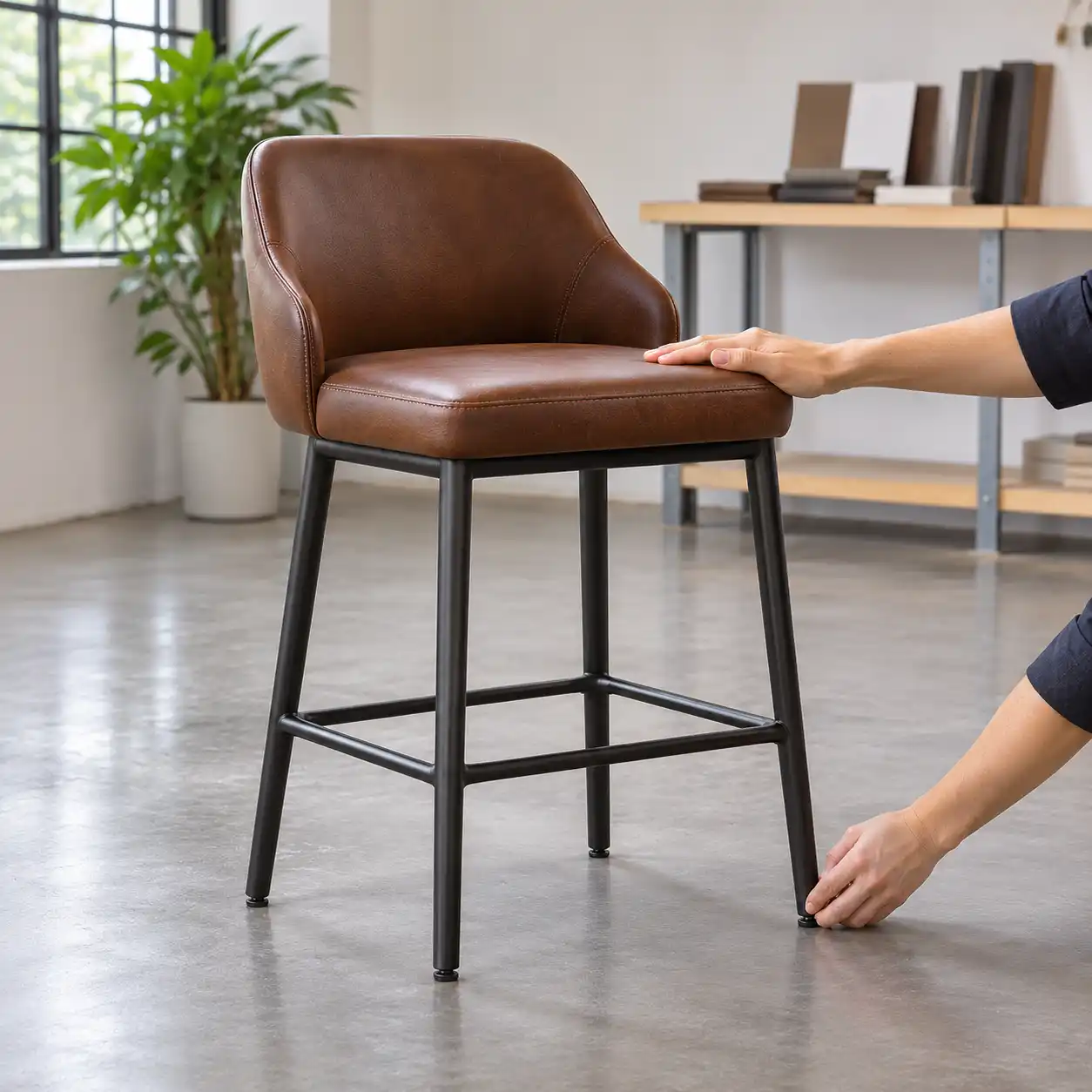
If one foot lifts while the stool rocks on a flat reference surface, check the floor, assembly, glides, and leg contact before concluding that the frame is defective. A small difference in the surface or an incorrectly seated glide can create movement that looks like a structural problem.
Record the surface and assembly condition. If the symptom disappears after the stool is correctly assembled or moved to a level surface, that is useful evidence. It does not, by itself, prove that every unit in the order is acceptable.
Side-to-side movement through the frame
A stool may stay in contact with the floor but still feel loose when pushed gently from the side. That movement can point toward the frame, joints, welds, fasteners, or the connection between the seat and its support.
Describe where the movement begins and where it can be felt. “The stool is unstable” is too broad for a useful supplier investigation. “The seat shifts relative to the base when lateral pressure is applied” gives the supplier a clearer place to start.

Movement at the seat, swivel, or height mechanism
A seat that moves independently of its base needs a different check from a stool whose legs rock on the floor. On swivel models, record whether the movement occurs during rotation or while the seat is held in position. On height-adjustable models, note whether the seat slowly changes height.
These are observations, not diagnoses. The same symptom can have more than one cause. A supplier should reproduce it on the exact configuration before recommending a correction.
| Observed symptom | First area to distinguish | Buyer record |
|---|
| One or more feet rock | Floor, assembly, glides, leg contact | Surface, assembly state, affected foot |
| Frame moves sideways | Joints, welds, fasteners, frame connection | Direction and location of movement |
| Seat shifts against base | Seat attachment, mounting plate, swivel assembly | Whether the shift occurs during rotation |
| Seat changes height | Height-adjustment mechanism, if fitted | Starting height and observed change |
Inspect the Stool as a Complete Structure
Four-leg stools: check contact, joints, and frame geometry
For a four-leg design, check whether the legs contact the reference surface consistently. Then inspect the joints, stretchers, welds or other connections, and visible fasteners. The construction details vary by model, so the drawing and approved sample should define what the buyer expects to see.
Do not treat “tighten every screw” as a complete inspection method. A loose fastener may be one finding; it does not explain why it loosened or confirm that the connection will remain secure in production. Record the location, condition, and whether the issue appears on more than one sample.
Pedestal and swivel stools: follow the load path
On a pedestal stool, movement can occur at the base, column, mounting plate, seat attachment, or swivel assembly. Check these interfaces separately. A firm base does not tell you whether the seat-to-column connection is secure, and smooth rotation does not establish that the complete stool meets the buyer’s stability requirements.
For a swivel model, compare the assembled sample with its approved drawing and configuration. Record movement when rotating the seat and when the seat is stationary. If movement or noise appears only during one of those actions, that distinction helps narrow the investigation.
Adjustable stools: check only the mechanisms fitted to that model
Some bar stools use a gas lift or another height-adjustment mechanism; others do not. For an adjustable model, record whether adjustment is smooth and whether the seat remains at its set position during the agreed check. Ask the supplier to identify the mechanism and provide documentation tied to the exact model.
The footrest also deserves attention where the design includes one. Confirm its position and connection against the approved specification. Do not ask staff to stand on a stool or footrest as an improvised load test. Any strength or stability test needs a defined method and appropriate equipment.
Build a Controlled Sample-Verification Plan
Set the baseline before comparing samples
Record the model and revision, components, assembly instructions, and sample configuration. Use a consistent, level reference surface and follow the supplied assembly process. Photograph the setup if different people will repeat the inspection.
Without a baseline, two inspectors may test different configurations and report different results. A sample with different glides, fasteners, or mounting hardware is not a like-for-like comparison.
Reproduce the movement in a controlled sequence
Start with the symptom reported by the customer: floor rocking, frame movement, seat-to-base play, swivel movement, or height loss. Check one movement at a time and record the direction, location, and conditions. Do not combine several actions and then guess which one caused the result.
If the symptom appears only after assembly, record the assembly steps and hardware used. If it appears after delivery, document the packaging condition and whether any component is displaced or damaged. These details help separate a product issue from an assembly or transit issue; they do not settle the cause without further inspection.
Compare results across the approved sample and production units
The approved sample should be identifiable by model, revision, and configuration. Buyers can then compare production units against the same reference, using criteria agreed with the supplier before production or shipment.
A single sample cannot establish batch consistency. The purchase documents should define the sampling plan, defect categories, and acceptance criteria. Those details belong to the specific order and product; there is no universal number that should be inserted into every bar stool inspection.
Read Test Reports by Scope, Not Just by Standard Number
Strength, durability, and stability answer different questions
A report title alone does not tell a buyer what was tested. Check whether the report addresses the concern at hand, which product configuration it covers, and what conditions and procedures were used.
For example, ISO 7173:2023 is titled Furniture — Chairs and stools — Determination of strength and durability. ISO describes its scope as structural strength and durability testing; it does not cover every possible property, such as ageing or upholstery-material durability.
ISO’s public catalogue also lists ISO/DIS 7173, a draft revision that includes stability in its title and remains under development. A draft is not the same as a published standard. Buyers should check the current status when they write a purchase specification.
Check whether the method fits the stool design
A named standard may exclude a design feature relevant to the product. ISO’s page for ISO 7174-1:1988, for example, describes upright chairs and stools but says its methods do not apply to swivelling or rocking chairs. That matters when the model includes a swivel function.
Ask the supplier to identify the standard and edition used, the tested model and configuration, the tests included, and any deviations. If the order requires a particular market or project specification, confirm applicability with the buyer, supplier, or qualified lab before production. BIFMA also describes different seating standards with different scopes in its standards information.
A report for a similar-looking stool should not automatically be treated as evidence for a model with a different base, swivel assembly, seat connection, or adjustment mechanism.
Turn One Complaint into a Bulk-Order QC Plan
Put the reference configuration into the order documents
The order should identify the model and revision, materials, relevant dimensions, components, assembly details, and approved sample. If the project has defined inspection or performance requirements, record those requirements and how they will be verified.
This gives the buyer and supplier a shared reference. If a component changes after approval, document the change and decide whether the sample or test evidence needs to be reviewed again.
Keep inspection findings traceable
For each observed defect, record the unit or batch, location, movement, setup, and evidence. The supplier’s response should connect the finding to a proposed cause, a corrective action, and a recheck on the revised sample or process.
“Adjusted” is not enough detail for a recurring issue. The buyer should be able to see what changed and whether the correction addressed the original symptom.
Check packing and spare-parts planning
Packaging can affect how a stool arrives, especially when components or hardware move during transit. Record the packaging configuration and condition on arrival, and agree in advance how transport damage or missing hardware will be handled.
For adjustable or swivel designs, ask which replacement components can be identified and ordered if needed. Confirm responsibilities, part references, and warranty terms in writing rather than assuming they are included.
Questions Buyers Should Ask Before Bulk Approval
How can I tell whether the floor or the stool is causing the wobble?
Assemble the stool according to its instructions and check it on a consistent, level reference surface. Record which foot or connection moves. If the movement remains, ask the supplier to inspect the exact sample and identify the affected interface.
Can I fix a wobbly stool by tightening the screws?
Only follow the manufacturer’s instructions for that model. Tightening a fastener may address a loose connection, but it does not confirm the underlying cause or prove that the production batch is acceptable. Take a stool with unresolved structural movement out of use until it has been inspected and addressed.
What should I request from the supplier?
Ask for the approved configuration, assembly instructions, model-specific test documents, inspection criteria, and a clear response process for defects. A report should identify what was tested and under which standard and edition; the buyer should verify that its scope matches the stool and project requirements.
Conclusion
A wobbly bar stool is a symptom that needs to be located before it can be assessed. Check the floor interface, frame, seat connection, swivel or adjustment mechanism, and the conditions in which the movement appears. For a bulk order, turn those observations into an approved reference sample, written acceptance criteria, traceable inspection records, and a corrective-action process.
For related selection factors, see our bar stool seating height guide, wholesale bar chair supplier guide, and bar chair range.





 English
 Español